
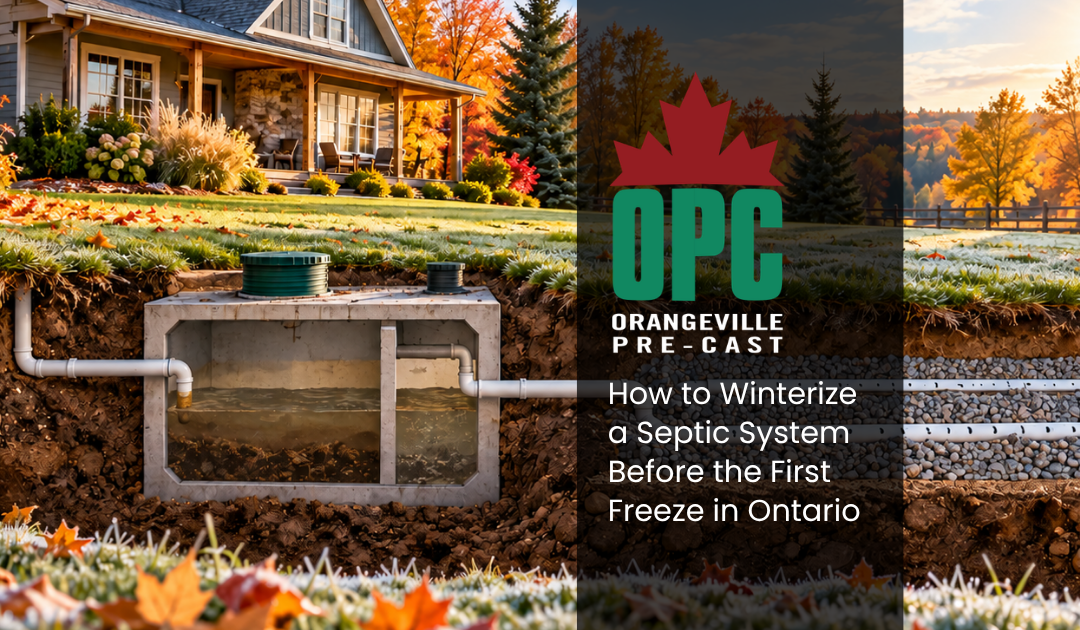
Winterizing a septic system means protecting the shallowest parts of it, the run of pipe between your house and the tank and the ground directly above the tank, before frost reaches them. Most Ontario freeze-ups start in that shallow line, not in the tank itself. This guide covers where systems actually fail, what frost depth means in Dufferin County, and what to check before the first hard frost.
What Winterizing a Septic System Actually Involves
Winterizing is not a single task. It is a check on three things: whether the shallow pipe runs are deep enough or insulated, whether the ground cover above the system is intact, and whether the tank has been serviced before the ground hardens. Nothing about it involves adding chemicals.
The work has to happen before the ground freezes. Once frost sets in across the Escarpment, a shallow line cannot be re-bedded, a lid cannot be excavated, and a pump truck cannot reach a buried access point without a day of digging.
TL;DR
- The house-to-tank line fails first. It is the shallowest pipe in the system and it carries intermittent, slow-moving flow.
- Snow is insulation, not a threat. Clearing snow off the leaching bed drives frost deeper into the soil.
- Southern Ontario frost depth is about 1.2 m, but elevation on the Niagara Escarpment pushes Dufferin County colder than the Toronto baseline.
- A concrete tank holds heat better than a light plastic one, because of mass and because it is typically set deeper.
- Install risers in October, not January. You cannot dig a buried lid out of frozen ground.
Where Ontario Septic Systems Freeze, in Order
1. The line between the house and the tank
This is the most common failure point and the one most articles skip. The line is shallower than the tank, it runs under a driveway or walkway where snow gets cleared away, and it carries short bursts of warm water separated by hours of nothing. A slow leak or a running toilet upstream makes it worse, because a thin trickle of cooling water is exactly what forms an ice collar inside a pipe.
2. The leaching bed
A bed that was already saturated in the fall is the one that freezes. Standing effluent near the surface turns to ice, and once the soil column is blocked, nothing else in the system can discharge. Compacted soil from vehicle or equipment traffic over the bed carries frost deeper and does the same thing.
3. The tank
The tank is the least likely component to freeze on an occupied home, because it holds a large volume of liquid at a stable temperature below grade. Tanks freeze on seasonal properties that sit unused, on systems buried too shallow, and where a riser or lid has broken its seal and is letting cold air straight down onto the liquid surface.
Frost Depth in Dufferin County and Why Elevation Matters
The working number across most of southern Ontario is 1.2 metres (4 feet), which is the minimum footing depth used through the GTA, Hamilton, and the Niagara region under the Ontario Building Code. That figure is a floor, not a guarantee, and your municipality has the final say.
Dufferin County sits higher than the places that number was written for. Elevation on the Escarpment produces a colder January design temperature than Toronto at the same latitude, which is why the frost-depth bands used for building purposes push Caledon and Halton Hills toward the central Ontario range rather than the southern one. Mono and the townships north of Orangeville sit in the same band.
Soil type shifts it again. Well-drained sand conducts heat away quickly and freezes deep. Saturated clay freezes slower and shallower but heaves far more, which is what lifts lids and shears pipe connections. If you do not know what your system is bedded in, that is the question to ask before you plan any winter protection.
Why a Concrete Tank Behaves Differently in a Freeze
A precast concrete tank carries far more thermal mass than a light plastic one. Mass moderates temperature swings, so the liquid inside changes temperature slowly even through a long cold snap. The tank also sits lower in most installs, because its weight means it does not need the shallow bedding and anchoring a buoyant plastic tank often requires in high groundwater.
Depth is the part that matters most. Under the Ontario Building Code, a septic tank must be built to hold sewage to a depth of at least 1,000 mm. That liquid column, set below grade with proper cover over it, is the system’s own buffer against frost. A correctly bedded tank from our septic tank product line is rarely the component that gives out in January.
Risers and Lids Are an October Job
If the access opening on your tank is buried under soil, you will find out how badly that matters the first time you need service in February. Frozen ground turns a ten-minute lid lift into a half-day excavation, and pumpers charge accordingly.
A riser brings the access opening to grade so the lid can be reached in any weather. The Ontario Building Code requires risers to conform to CSA B66 and to provide adequate access for regular maintenance of the tank. A properly seated riser and lid also closes off the cold-air path down onto the liquid surface, which is one of the few ways a tank on an occupied home can actually freeze.
Four Pieces of Winter Septic Advice to Ignore
|
Common advice |
Why it fails |
Do this instead |
|
Shovel snow off the bed so it does not freeze |
Snow is insulation. Bare ground lets frost drive deeper into the soil column |
Leave snow cover in place and keep equipment off the bed |
|
Leave a tap trickling to keep lines moving |
A thin, slow stream cools as it travels and builds an ice collar inside the pipe |
Fix running toilets and drips, then use normal full-volume flows |
|
Add a bacterial or enzyme product before winter |
Additives do not raise the temperature of anything. Freezing is a physics problem |
Pump the tank before an extended absence and correct any saturation in the bed |
|
Pack gravel around the lid so water drains away |
Loose gravel channels surface water toward the tank, where it freezes and lifts the lid |
Crown the grade above the tank so water sheds away from the access point |
Frequently Asked Questions
Can a septic tank freeze in Ontario?
A septic tank itself rarely freezes on an occupied home, because it holds a large volume of liquid below grade at a stable temperature. Freezing almost always happens in the shallow pipe between the house and the tank, or in a saturated leaching bed. Seasonal properties and cottages that sit empty all winter are the exception.
How deep does a septic tank need to be buried in Ontario?
Burial depth is set by the system design, the site, and the local frost depth rather than by a single province-wide number. Southern Ontario generally works from a 1.2 metre frost depth, and higher-elevation parts of Dufferin County can require more. Your permit drawings and your municipal building department govern the final depth.
Should I pump my septic tank before winter?
Pump before winter if you are due for service or if the property will sit unused for an extended period. Pumping does not prevent freezing on its own, but it removes the risk of a backup at the worst possible time and it is far cheaper and easier while the ground is still workable.
Is it too late to install a septic tank in the fall?
Installation continues into late fall in Ontario until the ground freezes, which typically means excavation stays workable well into November in an average year. Permit review and inspection timelines are usually the real constraint, not the weather, so confirm both with your principal authority before scheduling.
What are the first signs of a frozen septic system?
Multiple fixtures throughout the house draining slowly at the same time during sustained cold is the clearest sign, because a localized clog usually affects only one fixture. Gurgling drains and a pump alarm on a pump-equipped system are also early indicators. Stop water use and call a licensed septic professional.
Action Steps
- Walk the run from house to tank and note anywhere it passes under a cleared driveway or a shallow grade
- Fix running toilets and dripping fixtures now, before they become an ice collar in a pipe
- Check the grade above the tank and crown it so surface water sheds away from the access point
- Book a riser install before mid-October while the ground is still workable
- Keep vehicles and equipment off the leaching bed for the whole winter, and leave the snow where it lands
Septic freeze-ups in Ontario start in the shallow, slow-moving parts of the system, so the useful winter prep happens in the pipe runs, the ground cover, and the access points, not inside the tank.
About Orangeville Pre-cast: Orangeville Pre-cast has manufactured precast concrete septic tanks in Ontario since 1966, from its facility on Highway 10 in Mono and a second location in Hanover serving the Grey Bruce market. Questions about tank depth, risers, or accessories for your system can go to our team through the contact page.