
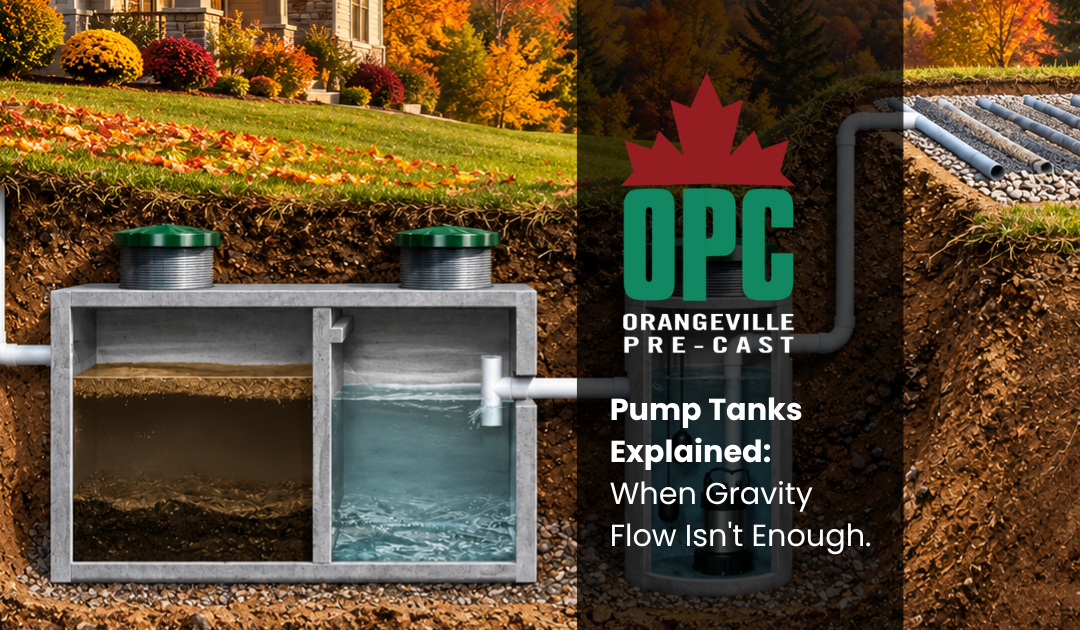
What Is a Pump Tank?
A pump tank is a watertight chamber, typically precast concrete, installed between the septic tank and the leaching bed. It holds effluent until a float switch triggers the pump to dose it out to the bed in controlled amounts, rather than letting it trickle out continuously. Every pump tank has three core components: a submersible effluent pump, float switches that turn the pump on and off at set levels, and a control panel with a high-water alarm that warns the homeowner if the pump fails.
TL;DR
- A pump tank moves effluent when gravity can’t. Required whenever the leaching bed sits higher than the septic tank or too far away for gravity to carry flow.
- It’s a separate chamber, not a bigger septic tank. The septic tank still does the solids-settling work; the pump tank only handles what comes after.
- Ontario’s Building Code (Part 8) governs the design. Pump chambers fall under the same permit and inspection process as the rest of the system.
- The pump and controls last roughly 10 to 15 years, shorter than the concrete tank, so budget maintenance attention there.
- A high-water alarm is a safety feature, not an optional extra. It’s the first sign of pump failure, long before a backup.
Why Pump Tanks Matter
1. Elevation Is the Most Common Trigger
The single biggest reason a lot needs a pump tank is elevation: the leaching bed sits at a higher grade than the septic tank, so gravity physically cannot carry effluent uphill. This shows up often on sloped rural lots across Dufferin County and Grey Bruce, where the flattest ground for a house sits below the best percolation soil for a bed.
2. Distance Reduces Gravity’s Effectiveness
Even on flat ground, a bed set far from the tank loses the fall needed for reliable gravity drainage. A pump restores even distribution across a bed that would otherwise get more flow at the inlet end than the far end, shortening the life of the whole system.
3. Raised and Pressure-Distribution Beds Need Even Dosing
Where soil conditions or a high water table push the design toward a raised or filter bed, a pressurized system is required whenever the site lacks the elevation gradient for gravity flow, or whenever uniform distribution across a large bed is needed to prevent premature failure at the inlet end, according to SepticReplacement.ca’s system comparison guide.
How a Pump Tank Works
Step 1: Effluent Collects in the Chamber
Liquid effluent, already separated from solids in the main septic tank, flows into the pump chamber and collects until it reaches a preset float level.
Step 2: The Pump Doses the Bed
The submersible pump switches on and pushes a measured dose of effluent through a pressurized forcemain to the distribution network, spreading it evenly across the bed instead of trickling continuously into one spot.
Step 3: The Alarm Watches for Failure
If the pump can’t keep up or fails outright, effluent keeps rising until it hits the high-water float, triggering an audible and visual alarm so the problem gets caught before it becomes a backup.
Pump Tank vs. Gravity System vs. Advanced Treatment
| System Type | How It Moves Effluent | Best For | Maintenance Load |
|---|---|---|---|
| Conventional gravity | Flows downhill by gravity alone | Flat lots with good soil and a bed lower than the tank | Lowest; tank pumping only |
| Pump (pressure-dosed) | Electric pump doses effluent to the bed | Sloped lots, raised beds, long runs between tank and bed | Moderate; pump and float service every few years |
| Advanced treatment unit (ATU) | Aerobic treatment, often paired with a pump | Small lots, high water tables, tight setbacks near water | Highest; regular service contract typically required |
Common Mistakes to Avoid
- Assuming a pump tank replaces the septic tank. It doesn’t. Solids still settle in the primary tank first; the pump tank only handles clarified effluent.
- Ignoring the alarm. A high-water alarm going off and getting silenced without investigation is one of the more common ways a pump failure turns into a backup.
- Skipping electrical planning. Pump tanks need a dedicated, code-compliant supply with the control panel in an accessible, weatherproof spot, not an afterthought.
- Forgetting seasonal access. In Dufferin and Grey Bruce winters, control panels and alarms need to stay visible under snow load, not buried behind a plow bank.
Orangeville Pre-cast supplies pump tanks, holding tanks, and the risers, filters, and chambers that go with a full septic system from its Mono facility, and stocks sizes small enough for a cottage addition up to large commercial capacities.
The Right Way to Plan for a Pump Tank
Framework: Site-First Design
Step 1: Confirm Grade Between House and Bed
A licensed designer surveys the elevation difference between the septic tank location and the proposed leaching bed before anything else is decided.
Step 2: Match Tank Size to Daily Design Flow
Pump tank capacity is sized against the home’s Daily Design Flow under the Ontario Building Code, the same bedroom-based calculation used for the primary septic tank. Ontario’s formula assigns roughly 750 litres of wastewater per day for the first two bedrooms, then about 350 litres for each additional bedroom, and a pump chamber has to be able to hold and dose that full flow reliably.
Step 3: Confirm the Permit Covers the Pump Chamber
The local principal authority (municipality, health unit, or county building department) reviews and permits the pump chamber as part of the full septic system design, not as a separate add-on.
Frequently Asked Questions
Does every septic system need a pump tank?
No. A pump tank is only required when the site can’t achieve gravity flow on its own, typically because the leaching bed sits higher than the tank or is set too far away for adequate fall. Flat lots with a bed below the tank generally use a conventional gravity system.
How long does a pump tank’s pump last?
The pump and its electrical controls typically last approximately 10 to 15 years before replacement, which is considerably shorter than the concrete tank itself. Budgeting for pump replacement as a maintenance item, separate from tank pumping, avoids surprises.
What happens if the pump fails?
Effluent continues to collect in the pump chamber until it reaches the high-water float, which triggers an alarm. If the alarm is ignored, effluent can eventually back up into the home’s plumbing, so a triggered alarm should always be treated as an immediate call to a service provider.
Is a pump tank the same as a holding tank?
No. A holding tank stores all wastewater for periodic pump-out and has no leaching bed at all. A pump tank is part of a full septic system; it only moves already-treated effluent to a bed, it doesn’t store sewage for removal.
Do pump tanks need regular maintenance beyond septic tank pumping?
Yes. Floats, pump seals, and alarm circuits should be checked periodically, separate from the primary tank’s pump-out schedule, since these are mechanical and electrical components rather than a static concrete chamber.
Action Steps
- Get elevation between your tank site and proposed bed surveyed before assuming a conventional gravity layout will work.
- Ask your septic designer whether your daily design flow and site grade require a pump chamber as part of the permit application.
- Locate the control panel and alarm somewhere visible year-round, not tucked where winter snow load will block it, and treat a triggered alarm as urgent.
- Confirm pump tank sizing and materials with your supplier when sourcing the primary septic tank, so excavation only happens once. See our post on concrete versus plastic septic tanks for more on material choice.
A pump tank exists to do one job, moving effluent uphill or across distance when gravity physically can’t, and it’s required by design, not by preference, whenever a lot’s grade or bed placement makes a conventional gravity system impossible. Ready to talk through your site?
Contact the Orangeville Pre-cast team for tank and pump chamber sizing.